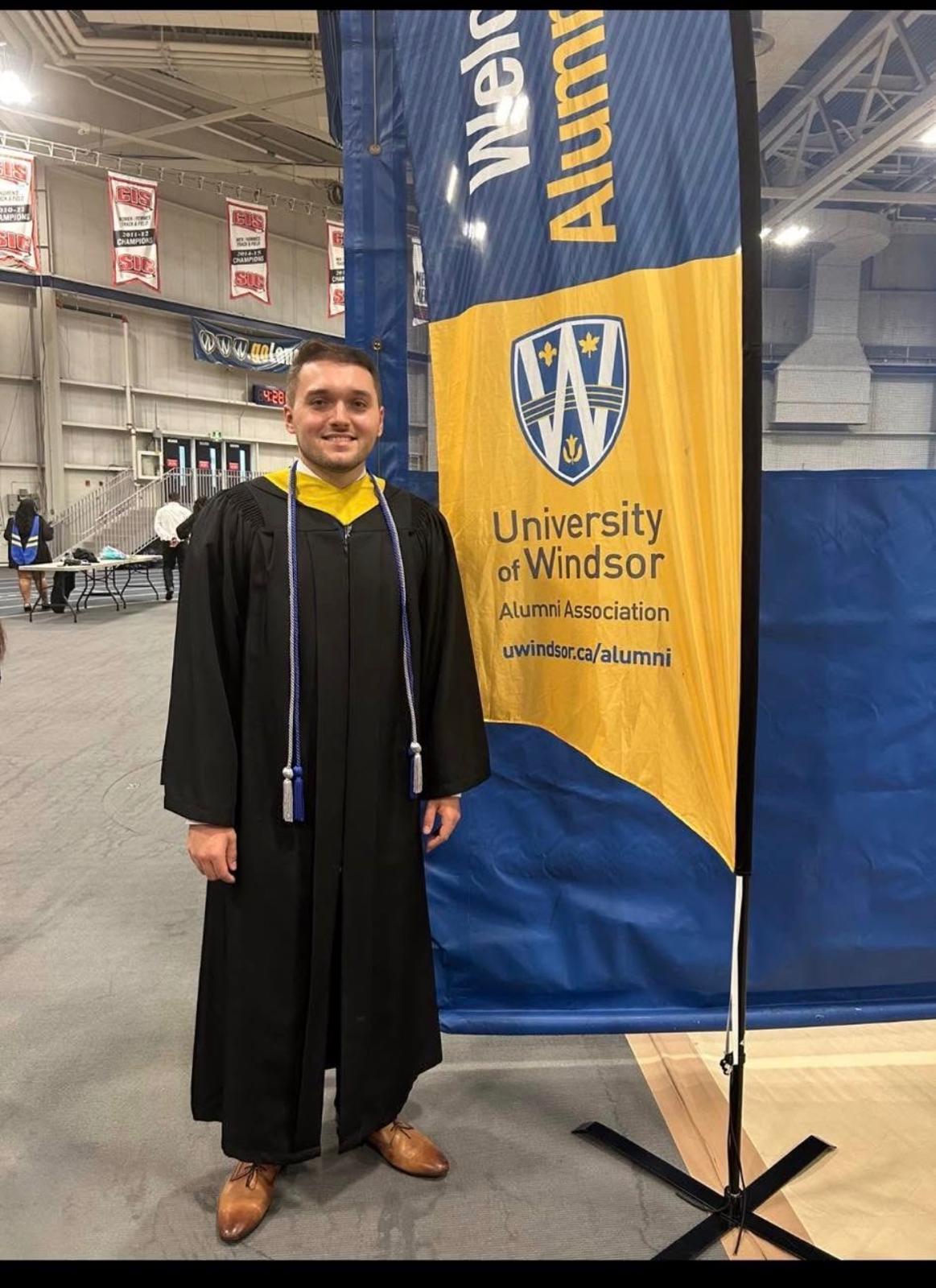
Software Engineer and MSc Student @ University of Windsor
Intro
Welcome to my personal website! Here, you can explore my journey and professional achievements.
If you're interested in a detailed overview of my experience, head over to the Resume tab. For more insight into who I am, including my passions and what drives my work, visit the About Me section. And if you’d like to connect, please feel free to reach out through the Contact tab.
Thanks for visiting, and enjoy exploring!
Resume
Education
M.Sc. Computer Science (AI Stream, Co-op) — University of Windsor (2025–Present)
Coursework: Deep Learning, Natural Language Processing, Software Engineering Topics
B.Comp.Sc. (Honours, Co-op, Software Engineering) — University of Windsor (2019–2024)
GPA: 4.0
Experience
Digital Cloud & Transformations Engineer Intern — Municipality of Lakeshore (Aug–Dec 2025)
Zero Trust networking with Cloudflare WARP, UDP 443/QUIC and NAT timeout diagnostics, MTU/fragmentation analysis,
PowerShell-based monitoring, infrastructure documentation in Confluence and Jira.
Research Assistant — University of Windsor (Jan 2023–Present)
Fine-tuned and evaluated LLMs (BERT, LLaMA, GPT) with feedback-driven optimization, achieving ~20% QA performance gains.
Graduate Assistant — University of Windsor (Jan 2025–Present)
Instructional support for Design & Analysis of Algorithms: dynamic programming, graph algorithms, NP-completeness.
Software Developer Intern — Ground Effects Ltd (Jan 2022–Jan 2023)
Full-stack development with React, Node/Koa, GraphQL; REST APIs in Kotlin/Spring; reporting with SSRS/Power BI;
Python + SQL server migration tooling; automated testing and performance optimization.
Research & Projects
Transformer-Based Automated Interlinear Glossing — Low-resource NLP system achieving 72.5% word-level
accuracy on SIGMORPHON 2023 datasets.
Condensed Variable Semantic Representations — GNN-based code embeddings using VDGs, InfoNCE, and
Deep Graph Infomax (Spearman up to 0.47 on IdBench).
Fine-Tuning LLMs for Question Answering — BERT/LLaMA on SQuADv2.0 with 4-bit quantization
(EM 82.1%, F1 84.1%).
Computer Vision (OpenCV) — Image processing and vision pipelines using OpenCV (see Projects section).
Graduation with Great Distinction (Top 5%) — University of Windsor
Dean’s Renewable Entrance Scholarship
Golden Key International Honour Society (Top 15%)
Competitive Research & Academic Funding — University of Windsor
Work & Research
Research focus: I work on improving sentence representations and self-supervised objectives for modern language models—bridging lightweight sentence encoders with LLMs such as BERT, LLaMA, and GPT-oss. My interests include contrastive learning, better negative mining, layer-wise representation analysis, and evaluation across semantic similarity, retrieval, and downstream NLP tasks.
Research Experience
University of Windsor – Research Assistant
Enhanced textual embeddings in BERT, LLaMA, and GPT-oss using contrastive‐learning objectives and custom loss functions.
Built a Transformer‐based interlinear glossing system, achieving 27–28% higher accuracy on SIGMORPHON 2023 shared‐task datasets.
Developed end‐to‐end pipelines for Question Answering and Sentiment Classification, improving QA accuracy by 15% and sentiment F1 by 10%.
Condensed Variable Semantic Representations
Constructed Variable Dependency Graphs (VDGs) from CodeSearchNet and fused VarCLR embeddings with graph features via a GCN encoder.
Employed InfoNCE contrastive loss and Deep Graph Infomax, achieving Spearman correlations of 0.47 (small split) and 0.45 (medium split) on IdBench.
Introduced a fallback projection for out‐of‐graph variables, retaining over 95% of full‐graph performance.
Hybrid Graph-Based Recommendation System
Developed a GNN + AutoEncoder movie recommender, achieving 90% rating‐prediction accuracy and an RMSE of 0.85.
Implemented adaptive thresholding based on users’ average history, boosting precision by 20% over non‐graph methods.
Work Experience & Development
Municipality of Lakeshore – Digital Cloud & Transformations Engineer Intern
Engineered and monitored secure cloud connectivity for 50+ municipal endpoints by supporting deployment and operation of the Cloudflare WARP client within a Zero Trust network architecture.
Designed and implemented advanced PowerShell-based network monitoring scripts to analyze UDP traffic (including UDP 443 / QUIC), detect NAT timeout behavior, and assess tunnel stability for remote users.
Developed diagnostic tooling to measure MTU path constraints, packet fragmentation, and transport reliability across wired and wireless networks, reducing root-cause analysis time by 30%.
Authored and maintained technical documentation in Confluence and tracked infrastructure issues and remediation tasks in Jira, contributing to standardized and auditable IT operations.
Ground Effects Ltd. – Software Developer Co-op
Built ReactJS frontends and Node.js/Koa/GraphQL backends for client-facing dashboards.
Created paginated SSRS and Power BI reports, delivering actionable insights to project managers.
Developed Python / T-SQL scripts to detect and fix 100+ database anomalies—reducing query times by 15% during a major server migration.
Automated end-to-end testing with Selenium and load-testing with Locust—identifying 15+ critical bugs, boosting throughput by 25%, and cutting page-load times by 20%.
Designed REST APIs in Kotlin/Spring Boot with caching and asynchronous processing, slashing response times by 30%.
University of Windsor – Graduate Assistant
Instruct hands-on Python labs covering data structures, algorithms, and debugging techniques.
Tutor students on algorithmic concepts such as Dynamic Programming, Graph Algorithms, and NP-Completeness, translating theory into practical code.
Collaborate with faculty to design assignments that reinforce algorithmic concepts and coding best practices.
Side Projects & Open-Source Development
Computer Vision project (OpenCV) — experiments and pipelines for vision processing. GitHub repo.
Transformer-based interlinear glossing app for low-resource languages—implemented unsupervised morpheme segmentation and cross-attentive decoding.
Flask-based blogging platform with Dockerized CI/CD (Jenkins), functional tests (Selenium), and load-testing (Locust)—improved test speed by 40% and performance by 15%.
Fine-tuned BERT and LLaMA on SQuAD v2.0 using 4-bit quantization—achieved over 80% Exact Match accuracy while halving training time.
Built a GTK4 + FFmpeg media player with multithreading for buffering, reducing startup latency by 30% and maintaining 60 FPS playback.
About Me
I’m George Kaceli, a software developer and researcher with a Bachelor’s degree in Computer Science from the University of Windsor, where I graduated with a 4.0 GPA. I’m the child of immigrants and proudly Albanian, and that background has strongly shaped how I approach challenges, with persistence, adaptability, and a drive to continuously improve.
Moving between cultures taught me early on how to learn quickly, communicate clearly, and stay resilient in unfamiliar environments.
Professionally, I have experience across both front-end and back-end development, having worked on projects ranging from scalable web applications to data-driven systems and machine learning pipelines.
Throughout my numerious internships I helped streamline workflows, optimize systems, and improve reliability through testing,
automation, and thoughtful engineering decisions. I enjoy building software that is not only technically sound, but also practical and maintainable.
Outside of tech, sports have always been a big part of my life, especially soccer. I enjoy following the game, analyzing tactics, and staying active,
and I find that many of the same principles apply to my professional life as well: teamwork, discipline, strategy, and constant iteration.
Whether I’m debugging a complex system or working toward a long-term goal, I bring that same competitive mindset and focus.
In my spare time, I enjoy exploring new technologies, working on personal and research projects, and deepening my skills in machine learning,
data science, and systems engineering. I’m motivated by hard problems and excited to continue building impactful software while growing as both an
engineer and a person.
Navigate from the Start node to the Target by traversing a graph of connected words.
Each move reveals whether you are getting semantically closer or farther from the goal,
providing warmer/colder feedback that mirrors distance in a high-dimensional embedding space.
Use PREV and NEXT to change puzzles